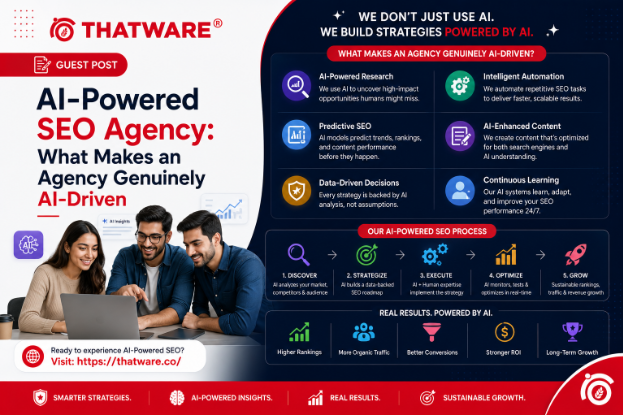
There’s a version of this conversation that happens in meeting rooms and on sales calls every week. A business is evaluating agencies. The agency says they’re AI-powered. The business nods. Nobody asks what that actually means. A contract gets signed. Three months later, the “AI-powered” deliverable turns out to be blog posts written with ChatGPT and keyword reports generated from the same tools everyone else uses.
It’s frustrating. And it’s avoidable — if you know what to actually look for.
Because there is a real difference between agencies that have bolted an AI label onto a traditional service offering and agencies that have genuinely rebuilt their approach around artificial intelligence. That difference matters enormously for the results you’ll get.
The Problem With “AI-Powered” as a Marketing Term
When AI became a buzzword in marketing — roughly 2023, maybe a bit before — every agency had a choice. Adapt genuinely or adapt on paper. A lot chose the latter because it was easier and clients weren’t asking hard enough questions.
The surface-level adaptation looks like: using AI writing tools to produce content faster, running keyword data through AI-assisted dashboards, maybe adding a section to the pitch deck about machine learning. None of that is wrong exactly. But it’s not a fundamental change in how SEO work gets done. It’s the same underlying process with some AI tools inserted at specific points.
The deeper adaptation is different. It means rethinking what SEO actually requires in an era where search engines are themselves AI systems — where Google’s ranking infrastructure is built on language models, where ChatGPT is a discovery channel, where the question isn’t “what keywords should we target?” but “how do we build semantic authority that AI systems recognize and trust?”
That second kind of adaptation is harder. It requires real expertise in how AI systems work, not just how to use AI tools. And it’s what actually moves the needle in 2026.
What a Genuinely AI-Driven Methodology Looks Like
Let’s get specific. A genuine AI-powered SEO agency approaches work differently at the methodology level, not just the tooling level.
They think about content in terms of semantic graphs rather than keyword lists. Instead of “we need to rank for these 50 keywords,” they’re asking “what does authoritative coverage of this topic space look like to a language model?” That means building interconnected content that covers a subject comprehensively — not just targeting individual queries in isolation.
They work with structured data not as a checkbox but as a core architecture decision. Schema markup, knowledge graph optimization, entity definitions — these are built into the content strategy from the start because they directly affect how AI systems understand and categorize what a brand is about.
They measure differently. Traditional SEO success metrics — rankings, organic traffic, click-through rates — still matter, but they’re supplemented with AI-specific signals: brand citation rates in LLM outputs, appearance in Google AI Overviews, share of voice in generative search across relevant queries.
And they build feedback loops. AI search is evolving fast enough that methodology needs to be continuously updated based on what’s actually working. Agencies doing this right are testing, iterating, and updating their approaches regularly — not running the same playbook from 18 months ago.
The Technical Foundation That Separates Real from Pretend
Here’s a concrete way to test whether an agency is genuinely AI-native: ask them about their technical approach to entity optimization.
Entity optimization is the process of ensuring that AI systems — Google’s knowledge graph, language models, search algorithms — can clearly identify a brand as a distinct entity with specific characteristics and areas of authority. It involves consistent NAP data across the web, structured markup that defines the entity clearly, earned mentions from authoritative sources in the relevant topic space, and content that consistently signals expertise in the domain.
Most traditional SEO agencies have a vague sense of this. Genuinely AI-driven agencies can walk you through their specific process — how they assess current entity recognition, what they build to strengthen it, and how they measure improvement over time.
Same goes for semantic content architecture. Can they explain how they structure content clusters to build topical authority? Can they show you what that looks like in practice? Can they explain the difference between content that ranks for keywords and content that earns citations in AI-generated answers?
Why This Actually Matters for Business Outcomes
The practical question is always: does this affect results? And yes, genuinely it does.
Brands that invest in AI-native SEO methodology are building visibility in channels that traditional SEO doesn’t touch. They’re showing up in ChatGPT answers, in Google AI Overviews, in Perplexity results. They’re building semantic authority that makes their content more likely to get cited across AI-generated content broadly.
That’s not a small thing. As AI-mediated search becomes the default experience for more queries and more users, the difference between brands that AI systems know and trust and brands that AI systems ignore is going to compound over time. The semantic authority you build now translates into citation patterns that become increasingly hard for competitors to displace.
An AI SEO agency that understands this isn’t selling you a service — they’re helping you build a structural advantage in a landscape that’s still taking shape. ThatWare has built their entire methodology around this kind of AI-native thinking, with specific processes for entity optimization, semantic content architecture, and LLM citation analysis. If you want to understand what this work actually looks like in practice, https://thatware.co/best-ai-seo-agency/ is a good starting point.
The Right Question to Ask
Before signing with any agency that claims to be AI-powered, ask one simple question: “What would your approach have looked like two years ago, and how is it different now?”
If the answer is essentially the same approach with different tools, you have your answer. If the answer reflects a genuine rethinking of how search authority gets built in an AI-mediated landscape — a different framework, different measurement, different content architecture — then you’re talking to someone who’s actually adapted.
That distinction is worth the extra time it takes to find out.